November 24, 2025 by Carlin Phillips (‘27)
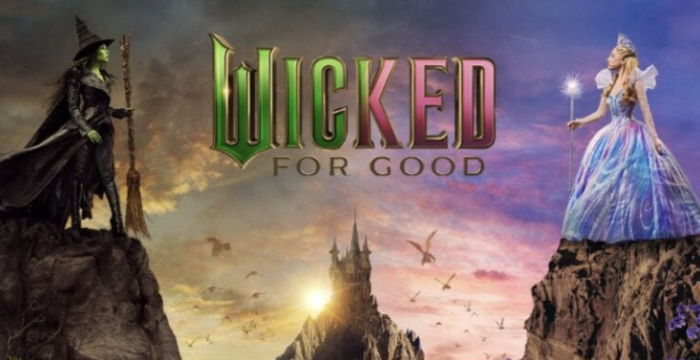
On November 21, 2025, the sequel to the movie Wicked, released last November, came out in theaters and blew up the internet and box office, attracting new and old fans. Wicked: For Good, has gotten numerous positive reviews since its release, and luckily, I got the opportunity to see it over this past weekend. Overall, I thought the movie was amazing and loved how thoughtfully it was directed. I thought this would be a great opportunity to share my thoughts on the film, so you can decide to see it for yourself.
The Wizard of Oz debuted as a major motion picture in 1939, starring actress Judy Garland, quickly becoming a classic in Hollywood and in homes all over the nation, bringing to life the 1900 novel, “The Wonderful Wizard of Oz,” written by L. Frank Baum. This film was one of the first pictures shot in Technicolor, marking a new beginning in the film industry. This story has continued on into the 21st century, as it was adapted into one of the longest-running musicals on Broadway in 2003, and made into a movie starring pop culture icons like Ariana Grande, Cynthia Erivo, and Jonathan Bailey. These renditions of Baum’s novel show a different perspective to the plot and a dynamic prequel to the original story.
To start, the addition of Glinda in “Wonderful”, a song reprised from the first movie, was a standout point in the soundtrack, which was initially sung by The Wizard of Oz and Elphaba. With Glinda being added, another layer to this song was too, showing a change in meaning and context within the storyline. By including Elphaba’s best friend to the song, the tone felt more solidified and supported, as it is about the Wizard trying to convince her to work with him again. Along with its amazing vocals, the visuals of the scenery and the instrumentals that went along with it made the song even more powerful.
Another thoughtful choice made throughout the movie was that Dorothy’s face was never shown, a calculated decision made to pay respect to the late Judy Garland, who played Dorothy in the original movie in 1939. This was to not take away from Elphaba and Glinda’s story, to avoid comparisons to Judy Garland’s portrayal of the character, as well as stay consistent with the broadway musical as well as the 2024 movie, where she is kept as a side character in the background of the plot.
There are many things in the movie that parallel the first one, and small details that make this sequel more interesting and developed. I loved how in the first part, which came out in November of last year, Glinda and Elphaba are separated by a door, before they share a dorm and eventually become best friends. This moment is parallelled in Wicked: For Good at the end of the film, after they sing the song “For Good”. This moment represents an arc in their friendship and a full circle moment in the storyline. While in the first movie it is in a more nervous and resentful context, the second moment is more melancholy, as two best friends who know they may never see each other again as their journey comes to a close.
Something that sticks out to me the most about this movie was the inclusion of two new songs: “No Place Like Home”, sung by Cynthia Erivo, and “The Girl in the Bubble”, sung by Ariana Grande. Although these songs were good, they weren’t as showstopping as the other songs in the movie. They were a bit more mellow, almost adding fluff to the movie that wasn’t necessarily needed. I had high hopes for “The Girl in the Bubble,” and was very excited to hear it, but I was left a bit disappointed in its execution.
Although I appreciated many of the producers choices in this movie, some of the casting left me with more questions than answers, and noticeable gaps to be filled. Madame Morrible is the second-hand villain to the Wizard in Wicked and was played by Michelle Yeoh. I was not a fan of Yeoh’s performance in either of the two movies, as I felt her voice didn’t fit the persona of Morrible and even her script was slightly lacking. The only thing she seemed to say the entire movie was “the Wicked Witch of the West is evil; we need to kill her!” It felt like she said this more times than she needed to, however, this may be a cinematic choice. Maybe a rethinking of casting for this villain would’ve helped to contrast the Wizard and Morrible more, as he is more the comedic villain and she is the more serious one.
Something I noticed that didn’t get as much screen time as I maybe wish it had was the backstory of Nessa, played by Marissa Bode, and how she became The Wicked Witch of the East. Maybe this could be another rabbit hole to take fans into? All we saw was the fact that she was a harsh governor of Munchkin Land, and that she was Elphaba’s sister. She’s referred to as The Wicked Witch of the East somewhat briefly in this movie, but more in the original Wizard of Oz; but we never learn why she is called that. They did not give us any backstory into Nessa’s life which was quite odd and made the jump from her being at Shiz to being governor quite confusing.
However, some of these left out moments weren’t as necessary as a tie to the Broadway musical. One of the best scenes in the movie was the last in my opinion. Right before the credits, Glinda can be seen whispering in Elphaba’s ear as an homage to the poster used for the Wicked musical on Broadway. It was such a beautiful moment, and I loved this tasteful tribute to not only the musical, but the original cast of Elphaba and Glinda played by Idina Menzel and Kristin Chenoweth.
Even though there were portions of the plot that had gaps, overall, the message left a large impression on me. The sets were beautiful and the cast was amazing as well. Erivo and Grande did an amazing job filling the roles of Elphaba and Glinda. The two had such great platonic chemistry, and their voices were so strong, while not competing with one another but blending. Overall, I loved this movie, and I highly recommend seeing it while it’s in theaters, though you may want to watch the first movie before you do, since it will make the second one more enjoyable.
photo source: mediaweek.com